Grey seal or harbour seal?
Two species, easily mixed up from a distance. Use the head, the nostrils, the coat and the time of year.
Heads and noses
In profile, grey seals have a flatter, more ‘Roman’ nose; harbour seals have a dished, dog-like face with a clearer forehead. SMRU: Identifying seals leaflet Grey seals often show a double chin; harbour seals do not. SMRU: Identifying seals leaflet
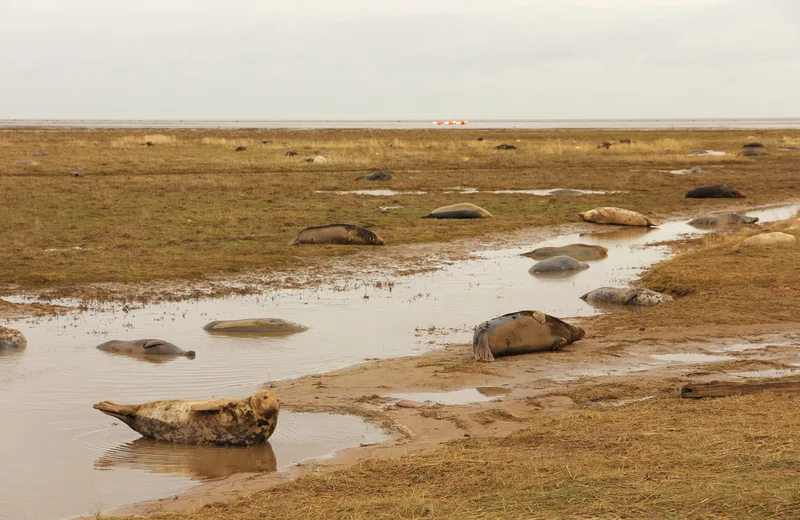
Grey seals have nearly parallel nostrils; harbour seals have V-shaped nostrils that almost meet at the bottom. Natural History Museum: Seals in the UK The grey seal’s scientific name, Halichoerus grypus, means ‘hook-nosed sea pig’. Natural History Museum: Seals in the UK
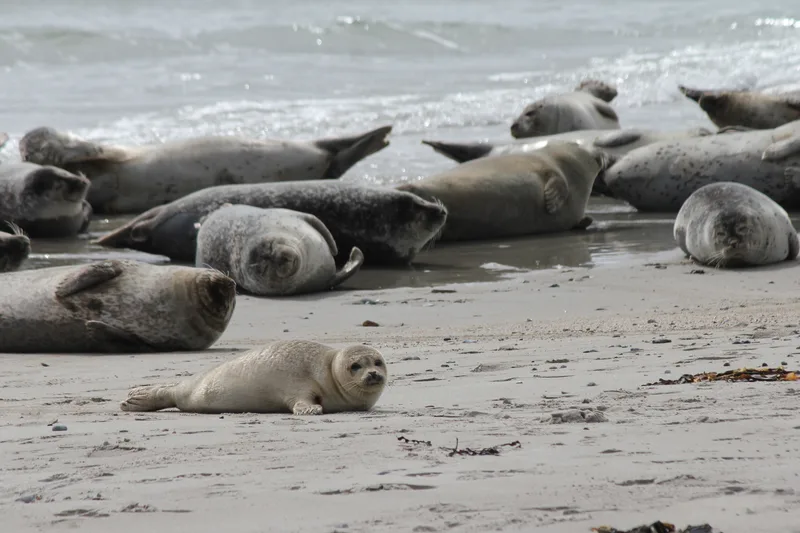
Spots and coats
Harbour seals are usually more evenly spotted; grey seals often show larger, more irregular blotches and a clearer contrast between a pale belly and a darker back. SMRU: Identifying seals leaflet
A wet coat, a dry coat and a moulting coat can look surprisingly different — the Sea Mammal Research Unit’s identifying leaflet is the best pocket guide.
When the pups arrive
Grey seals around the UK mostly pup between September and December (timing varies by coast: earlier in the west, later in the east). Natural History Museum: Seals in the UK Harbour seals usually pup in June and July. Natural History Museum: Seals in the UK
Grey seal pups are born with fluffy white coats and stay ashore for about two to three weeks before entering the water. Natural History Museum: Seals in the UK Harbour seal pups are born ready to swim and can enter the water within a few hours of birth. Natural History Museum: Seals in the UK
- Britain’s shores hold a large share of Europe’s grey seals: the Natural History Museum puts the UK population at about 120,000, roughly 40% of the world total and about 95% of the European population. Natural History Museum: Seals in the UK
- UK grey seal pup production in 2022/23 was estimated at about 79,122 — the highest total on the SCOS record — with over 70% of those pups in Scotland. SCOS scientific advice on UK seal populations (2025 report) · checked 5 Nov 2026
The Natural History Museum’s “about 120,000” is a population round figure; SCOS’s 79,122 is annual pup production, not the same thing. Every disagreement we found →
Next: bodies & diving →