The UK’s two breeding seals
Only grey seals and harbour seals live and breed around Britain all year. Arctic visitors turn up now and then, but these two are the residents.
Two seal species live and breed around the UK all year: the grey seal and the harbour seal (also called the common seal). Natural History Museum: Seals in the UK
Britain’s shores hold a large share of Europe’s grey seals: the Natural History Museum puts the UK population at about 120,000, roughly 40% of the world total and about 95% of the European population. Natural History Museum: Seals in the UK Harbour seals are also called common seals, but in the UK they are the less common of the two species. Natural History Museum: Seals in the UK
Red List categories below were checked 5 Nov 2026. Follow the IUCN links for the latest reassessment.
No. 01 · Halichoerus grypus
Grey seal
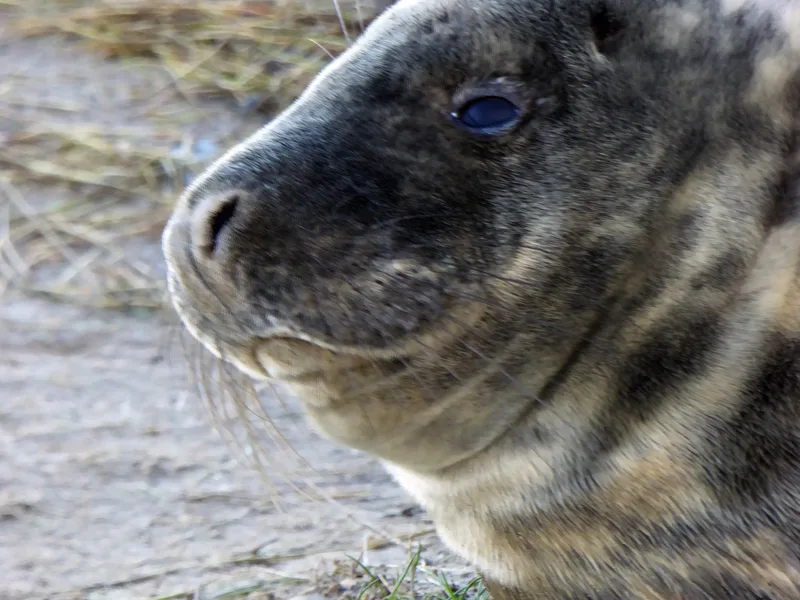
- The grey seal is Britain’s largest resident seal. Adults can grow to more than 2.5 metres long and weigh up to about 300 kg. Natural History Museum: Seals in the UK
- In profile, grey seals have a flatter, more ‘Roman’ nose; harbour seals have a dished, dog-like face with a clearer forehead. SMRU: Identifying seals leaflet
- Grey seals have nearly parallel nostrils; harbour seals have V-shaped nostrils that almost meet at the bottom. Natural History Museum: Seals in the UK
- The grey seal’s scientific name, Halichoerus grypus, means ‘hook-nosed sea pig’. Natural History Museum: Seals in the UK
- Grey seals around the UK mostly pup between September and December (timing varies by coast: earlier in the west, later in the east). Natural History Museum: Seals in the UK
- Grey seal pups are born with fluffy white coats and stay ashore for about two to three weeks before entering the water. Natural History Museum: Seals in the UK
- Grey seals mainly eat fish (including sand eels, cod, flatfish and others) and also take squid, octopus and crustaceans. Natural History Museum: Seals in the UK
- The IUCN Red List assesses the grey seal (Halichoerus grypus) as Least Concern globally, with an increasing population trend. IUCN Red List: Grey seal (Halichoerus grypus) · checked 5 Nov 2026
- UK grey seal pup production in 2022/23 was estimated at about 79,122 — the highest total on the SCOS record — with over 70% of those pups in Scotland. SCOS scientific advice on UK seal populations (2025 report) · checked 5 Nov 2026
- Britain’s shores hold a large share of Europe’s grey seals: the Natural History Museum puts the UK population at about 120,000, roughly 40% of the world total and about 95% of the European population. Natural History Museum: Seals in the UK
No. 02 · Phoca vitulina
Harbour seal
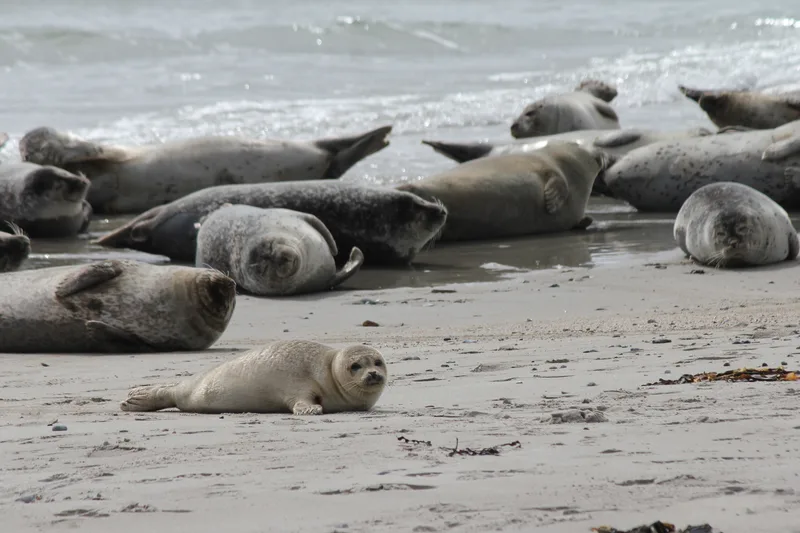
- Harbour seals are smaller: roughly up to about two metres long and around 70–150 kg. Natural History Museum: Seals in the UK
- Harbour seals are also called common seals, but in the UK they are the less common of the two species. Natural History Museum: Seals in the UK
- In profile, grey seals have a flatter, more ‘Roman’ nose; harbour seals have a dished, dog-like face with a clearer forehead. SMRU: Identifying seals leaflet
- Grey seals have nearly parallel nostrils; harbour seals have V-shaped nostrils that almost meet at the bottom. Natural History Museum: Seals in the UK
- Harbour seals usually pup in June and July. Natural History Museum: Seals in the UK
- Harbour seal pups are born ready to swim and can enter the water within a few hours of birth. Natural History Museum: Seals in the UK
- Harbour seals take a varied mix of fish such as herring, sand eels and cod, plus squid, octopus and sometimes crustaceans. Natural History Museum: Seals in the UK
- The European IUCN assessment for the harbour seal (Phoca vitulina) is Least Concern, though some local populations are of concern. IUCN Red List: Harbour seal European assessment · checked 5 Nov 2026
- Based on surveys between about 2016 and 2023, SCOS estimates the total UK harbour seal population at about 36,956 (95% confidence interval about 30,200–49,300). SCOS scientific advice on UK seal populations (2025 report) · checked 5 Nov 2026
- SCOS reports that harbour seal numbers are declining and/or depleted in most UK Seal Monitoring Units with notable numbers. SCOS scientific advice on UK seal populations (2025 report) · checked 5 Nov 2026